What operational excellence software should do
Most plants already run OpEx: a tier meeting in the morning, 5S walks, a defect register, an A3 for the big problems, a kaizen board and a maintenance log. The trouble is that each lives in a different place: a whiteboard, an Excel file, a WhatsApp group, a binder. Nothing connects, so a problem raised on Monday is lost by Friday.
Operational excellence software earns its place only if it connects those steps, so that one record follows a problem from the moment someone sees it to the moment it is fixed, verified and taught to the next shift.
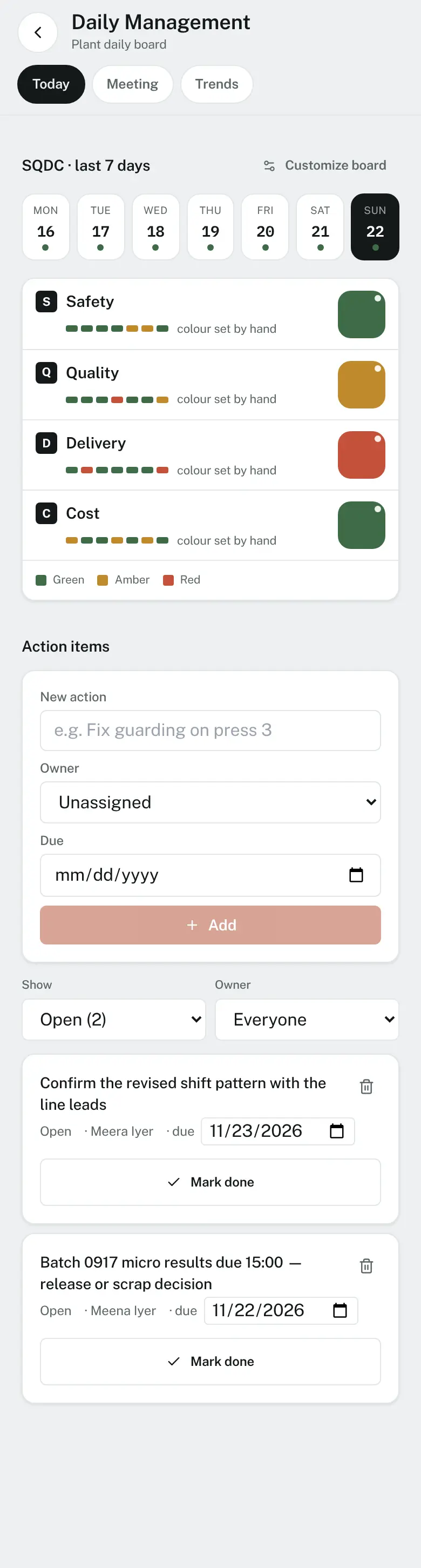
- Daily management: tier boards for safety, quality, delivery, cost and morale, with every red given an owner and a date.
- Find: 5S audits, layered process audits, safety walks and quality checks on the phone, with photos.
- Fix: defects with owners, due dates and before-and-after photos, escalated when they stall.
- Understand: 5 Whys, fishbone and A3 for the problems that keep coming back.
- Improve: kaizen ideas through approval to a verified savings ledger in rupees.
- Keep: one-point lessons, SOPs and a skill matrix, so the fix becomes the standard.
How LeanOS runs the OpEx loop
Every module in LeanOS writes to the same record. A finding from a 5S walk becomes a defect with an owner; a defect that repeats becomes an A3; a countermeasure that works becomes a one-point lesson; the money it saves lands on the savings ledger, which finance can check line by line.
Closing is a two-step job on purpose: the person who did the work submits the evidence, someone else verifies it. That one rule is what stops a defect register from filling with ticks that nobody believes.
Built for Indian mid-size plants
LeanOS is made for plants of 50 to 500 people: auto components, food, pharma, packaging, textiles and engineering. It runs in the phone's browser, works offline on the floor, and brings in what you already keep in Excel, Google Sheets or Tally, so nobody types the same number twice.
It is built around the standards your customers audit you against: IATF 16949, ISO 9001, GMP and HACCP, with signed, time-stamped records and a tamper-evident audit log.
Start without a big rollout
The 7-day trial opens on a sample plant from your industry, so you see the loop working before you add a single zone. Most plants start with one area and one daily meeting, then add maintenance and quality once the habit holds.